The most famous unsolved problem in mathematics may have just fallen, and an AI was there at the finish line. On Friday, November 20, 2026, Anthropic mathematician Levent Alpöge announced that he and Claude have found a proof of the Riemann Hypothesis, a question that has stood for 167 years. He says the same method also proves the far bigger Generalized Riemann Hypothesis.
If it holds up, this is the most groundbreaking result in mathematics in living memory, and the first time a machine helped crack a problem the best human minds agreed was nowhere near solved.
“I believe I have, working with Claude, discovered a proof of the Riemann Hypothesis.”
Levent Alpöge, in his announcement
Here’s the catch, stated once: the proof is not verified yet. There is no paper and no peer review. What exists is a giant computer-checkable proof, and public checks started the same day.
The problem that guards the primes
Prime numbers (2, 3, 5, 7, 11…) look scattered at random along the number line. In 1859, Bernhard Riemann suggested they follow a deep hidden order, tied to where a special function, the zeta function, equals zero. His guess: all the interesting zeros sit on one single straight line.
Prove that, and you get the best possible control over how the primes are spread out. It became, as Scientific American puts it, “the North Star for the entire field of number theory.” It is one of the Millennium Prize Problems, with $1 million from the Clay Mathematics Institute for an accepted solution.
Its real power is inside math. Many results are written as “if the Riemann Hypothesis is true, then…”. As mathematician James McKee told New Scientist: “There are numerous results that are conditional on the generalised Riemann hypothesis, and now those are theorems!” Don’t expect it to break your bank’s encryption, though. Scientific American is blunt: it “won’t upend global banking or make the internet run faster.”
How Claude got there
Alpöge is no outsider. He is a number theorist and former Harvard Junior Fellow, now at Anthropic, who in July posted a Claude-generated counterexample to the famous Jacobian conjecture. He says the Riemann Hypothesis was his secret goal since his student days.
His four-page note reads like a love letter, and Claude is the star. Alpöge set up the strategy, then, in his words, “Claude far outpaced me near the finish line. No, Claude flew, and danced, and sparkled near that finish line.”
Some of the most striking details:
- About six weeks. The timeline in his note starts on October 6, 2026. Many key steps landed on November 15, and the last entry, on November 16, reads simply “GRH.”
- Over 250,000 pages. That’s how long an unpublished written version ran. He chose not to post that “massive unreadable travesty of ‘slop’.”
- 175,187 Lean files instead. He released the proof in Lean, a language where a computer checks every logical step. Alpöge says it is formalized “without assumptions.”
- He admits he doesn’t fully understand it yet. Parts rely on areas where “Claude is the expert and not me,” and he expects much shorter proofs to follow.
The timing raised eyebrows. The announcement came one day after Anthropic’s stock market debut on November 19. Alpöge addresses it head-on, saying there was “a constraint to respect” and calling the cynical reading “false.”
What mathematicians are saying
The first reactions mix awe and caution.
“This is indeed an historic moment. The world has changed.”
Andrew Sutherland, MIT, after compiling the proof in Lean himself, to Scientific American
Hector Pasten of the Pontifical Catholic University of Chile says that if it’s correct, it completes a dictionary between branches of math, “something like a Rosetta Stone.” Carlo Pagano of Concordia University expects the ideas to “open up brand new avenues of thinking in number theory.”
Kevin Buzzard of Imperial College London, one of Lean’s best-known champions, kept it short: “Let’s see if it compiles first.”
The crowd checking the proof
Last updated: November 20, 2026, 20:04 UTC. The verification is still running, and we’ll update this post regularly as it progresses.
Lean makes this claim unusually testable. If the code builds and the final statement really says what Riemann said, the logic is checked by machine. But building 175,187 files takes enormous computing power, so the internet stepped in.
The same day, a public project, alpoge-rh-replay, split the proof into 175,187 module tasks and 2,858 work packets. Volunteers claim a piece, build it on their own machines or cloud servers, and send back receipts that maintainers review. By Friday evening (UTC), 42 volunteers had signed up. I’m one of them (@emsi on the volunteer list), and anyone can join.
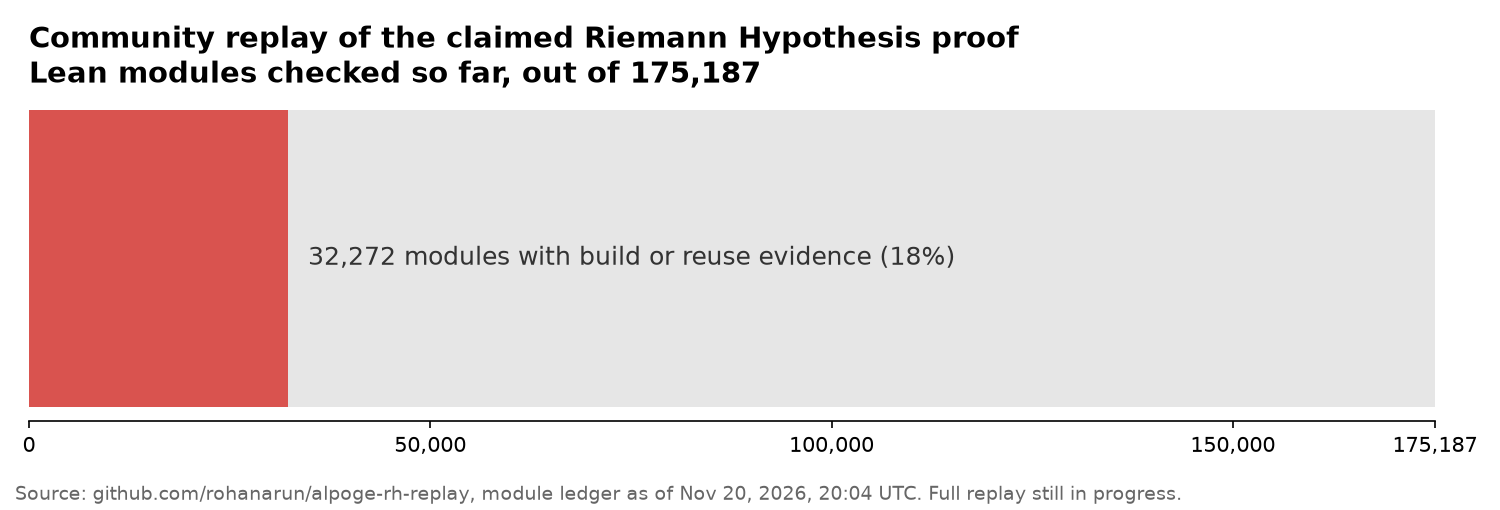
As of 20:04 UTC on November 20, 32,272 modules had build or reuse evidence, about 18%. The project states plainly that no full verification receipt exists yet. You can follow it on the live dashboard.
A second effort, rh-lean-check, is running Lean’s official comparison tool. So far:
| Check | Status (Nov 20) |
|---|---|
| Source matches the published archive | Pass |
| Theorem statements compile against Lean’s standard math library | Pass |
No shortcuts in the code (sorry, extra axioms and the like) |
Pass |
| Statements match, plus full kernel replay | Running, takes hours |
Two questions decide everything. Does every file build? And does the final theorem match the real Riemann Hypothesis? The good news on the second one: the main theorem uses the standard library’s own definition of the hypothesis. One detail matters for the bigger claim, though: the “Generalized” part covers Dirichlet L-functions, not every generalization mathematicians have in mind.
Why this matters beyond math
A year ago, AI models stumbled on college math. Now one may have helped settle the question that defined number theory for a century and a half. Sutherland once told Scientific American: “An AI that can prove the Riemann hypothesis is not one I’d want to meet.” Today he called it “a human triumph, and a day for celebration.”
Alpöge ends his note on the same mix of loss and wonder: “It is natural to feel that this is an end, in my case a loss of a principal guiding light, but what I saw during the course of progress so amazed me that I believe it is one dawn across science of something far greater.”
Checking the code should not take long. Understanding what Claude found may take mathematicians much longer.
Sources
- Levent Alpöge, announcement note (PDF), November 20, 2026
- Joseph Howlett, “Anthropic mathematician claims to prove Riemann hypothesis, most famous problem in all of math”, Scientific American, November 20, 2026
- Matthew Sparkes, “Anthropic mathematician claims AI-assisted proof of the Riemann hypothesis”, New Scientist, November 20, 2026
- alpoge-rh-replay, community replay project, and its live dashboard
- rh-lean-check, independent Comparator check
- Clay Mathematics Institute, The Riemann Hypothesis