What if an AI agent could practice inside a simulated world before touching the real one?
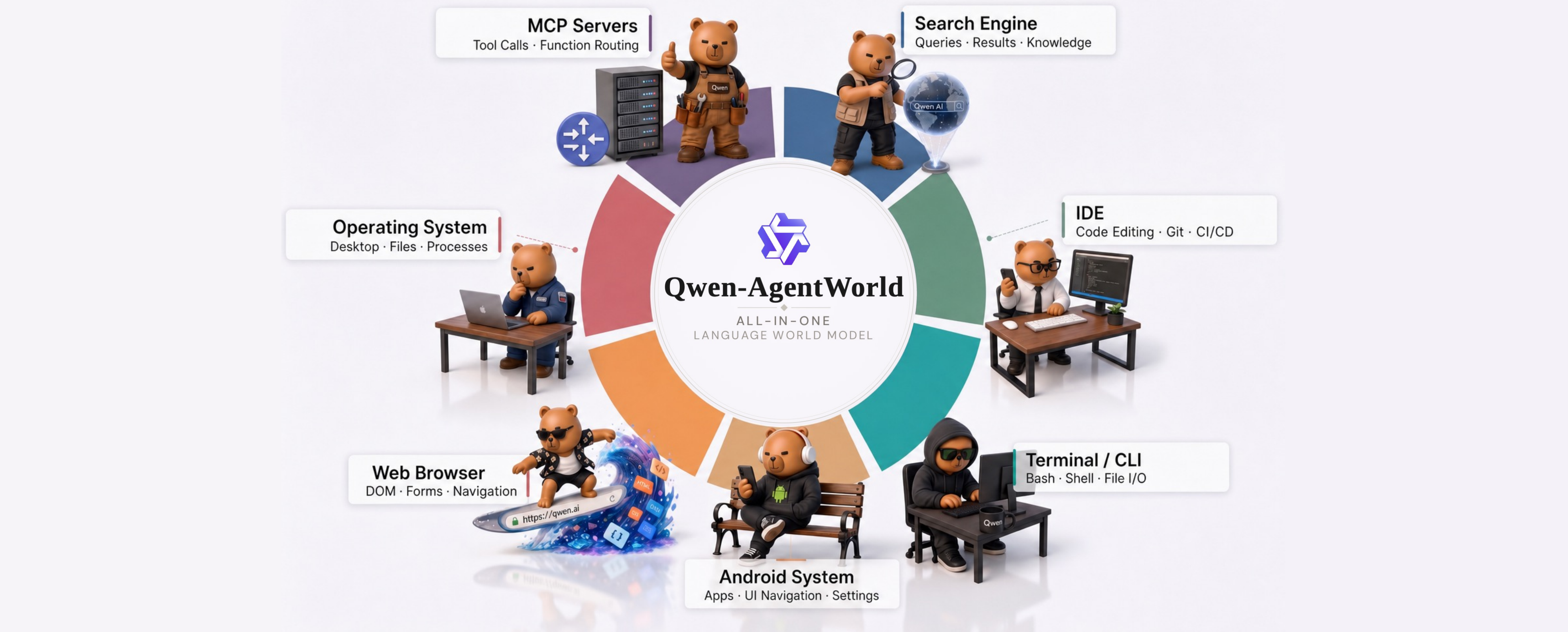
That is the idea behind Qwen-AgentWorld, an open-source language world model that doesn’t primarily learn how to answer questions—it learns how environments respond to an agent’s actions. Instead of predicting the next word in a conversation, it predicts what a terminal prints after a command, how a web page changes after a click, what an API returns, or how an Android interface evolves after a tap.
It is a subtle shift in training objectives, but one with interesting implications for the future of AI agents.
Unlike conventional language models that later receive agent-specific fine-tuning, Qwen-AgentWorld is trained for environment simulation from the very beginning. The developers describe a three-stage pipeline where continual pre-training injects knowledge about interactive environments, supervised fine-tuning teaches explicit next-state prediction, and reinforcement learning improves simulation fidelity. According to the project, the model was trained on more than 10 million real interaction trajectories spanning terminals, browsers, Android, operating systems, search engines, APIs, and software engineering workflows.
The result is a single model capable of simulating seven different kinds of environments using only structured text. GUI environments are represented through HTML, accessibility trees, or UI hierarchy markup instead of pixels, allowing the model to reason about interfaces without image processing.
One particularly interesting aspect is that the project is not trying to replace real execution. Instead, it treats the world model as a training partner for future agents.
Imagine an agent learning software development. Normally it would need thousands of interactions with real terminals, containers, browsers, databases, and APIs. Those environments are expensive to maintain, difficult to scale, and often impossible to manipulate in controlled ways. A language world model can instead generate realistic responses while deliberately introducing edge cases that rarely happen in production.
That allows researchers to teach agents how to recover from broken APIs, misleading search results, incomplete tool outputs, permission errors, or inconsistent system states long before they encounter them in reality.
Perhaps the most surprising claim is that these simulated environments can actually produce stronger agents than training exclusively in real environments. The authors report that carefully controlled simulated reinforcement learning surpassed reinforcement learning performed against a live search engine in one of their experiments. Whether this generalizes remains to be seen, but it is an intriguing direction.
Another fascinating observation comes from the model’s reasoning traces. The researchers found recurring behaviors such as deliberate self-correction, avoiding accidental information leakage, and constructing long causal chains before predicting environment state. Those traces suggest that environment simulation requires considerably more than memorizing outputs—it demands reasoning about hidden state, dependencies, and cause-and-effect.
Equally notable is the hardware story.
Recent open-weight releases have been enormously capable but also enormously demanding. GLM-5.2, for example, is based on a 744B-parameter Mixture-of-Experts model with roughly 40B active parameters per token, putting practical self-hosting firmly into multi-GPU server territory. (GitHub)
Qwen-AgentWorld takes a much more approachable route. The released model uses a 35B total / 3B active Mixture-of-Experts architecture with a 256K context window. That is still a serious model, but it moves into territory that many AI enthusiasts, researchers, and small teams can realistically experiment with using locally available multi-GPU workstations instead of datacenter-scale hardware.
That accessibility matters.
Open-weight models become significantly more valuable when people can actually run them, inspect them, modify them, and build on top of them. A world model is especially interesting in this regard because it opens entirely new experimentation possibilities. Researchers can investigate agent behavior, reinforcement learning, planning, and environment simulation without needing enormous infrastructure just to reproduce published work.
Alongside the model, the team also released AgentWorldBench, a benchmark containing paired predictions and real environment observations across seven domains. Having an openly available benchmark makes it easier for others to compare new approaches against a shared reference rather than relying solely on proprietary internal evaluations.
Whether language world models become a standard ingredient of future AI agents is still an open question. But the underlying idea is compelling: before acting, learn to predict the consequences of those actions.
That sounds remarkably similar to how humans approach many complex tasks.
For anyone interested in agents, reinforcement learning, or open-source AI infrastructure, Qwen-AgentWorld is well worth exploring. The project combines an unusual research direction with something the community always appreciates: weights, benchmarks, and tooling that anyone can inspect and build upon.
If you’d like to dive into the technical details, the complete announcement is available at https://qwen.ai/blog?id=qwen-agentworld.