You ask ChatGPT to explain something and get back a neat paragraph. Every sentence is grammatical, the words are familiar, and the logic holds. Still, you reach the end with the sense that something slipped past you, so you go back, reread a phrase, and work out who did what to whom. The information was all there. Getting it out was your job.
A new paper by Thomas Hikaru Clark (NYU), Matias B. Martin and Kyle Mahowald (UT Austin) argues that this feeling has a measurable cause. In Why is AI-generated language so hard to understand?, they open with a sentence written in the style they study: “Your instinct is right; the convoluted sentence you are currently reading is quietly eating its own reader-patience budget — footnote it.” If that reads like a chatbot to you, the paper explains why.
The work you do without noticing
Reading is not a simple left-to-right scan. You hold words in working memory until you know how they connect. Some sentences make that easy and some make it expensive. The paper gives a pair like this one:
The house that the contractors built
The house that was built by the contractors
Both say the same thing. In the first, an object relative clause, you meet the house and then the contractors, and only at “built” do you learn who did what to whom. In the second, a passive, “was built” comes right away and settles the house’s role, and “by the contractors” then names the builder. The second is two words longer, yet object relatives are the kind known to be harder to process. The authors predict models will favor them for exactly that reason.
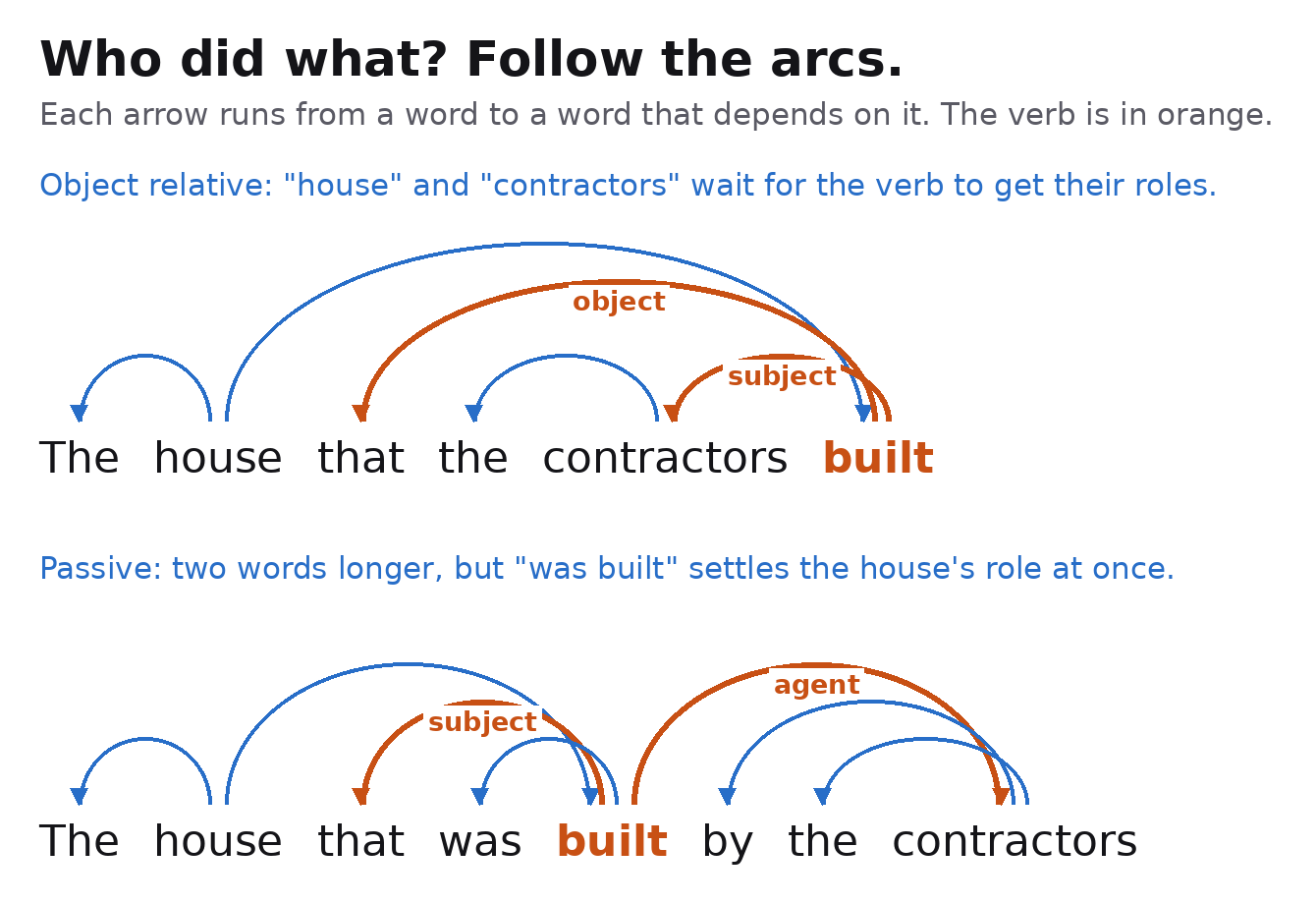
Psycholinguists have long known that constructions like these slow readers down. The authors ask whether language models use them more often than people do.
What the study measured
The authors gathered text from nine frontier and near-frontier models (four Claude models, three from OpenAI’s GPT-5.6 family, GLM-5 and Kimi K2.5), with smaller Llama 3.1 and Olmo 3 models as a reference point. The models chatted with a simulated user, fixed real bugs in public GitHub repositories, and wrote persuasive essays to school assignment prompts.
In all that text, they counted six such constructions:
- Rare word pairs that seldom appear together in human text.
- Long dependencies, words that belong together but sit far apart.
- Object relatives without “that”, as in “the book the professor wrote”.
- Stacked nouns, such as “horror movie soundtrack generator”.
- Nouns used as verbs, as in “calendar it”.
- Inanimate subjects doing animate things, as in “the whole conversation is eating its own tail”.
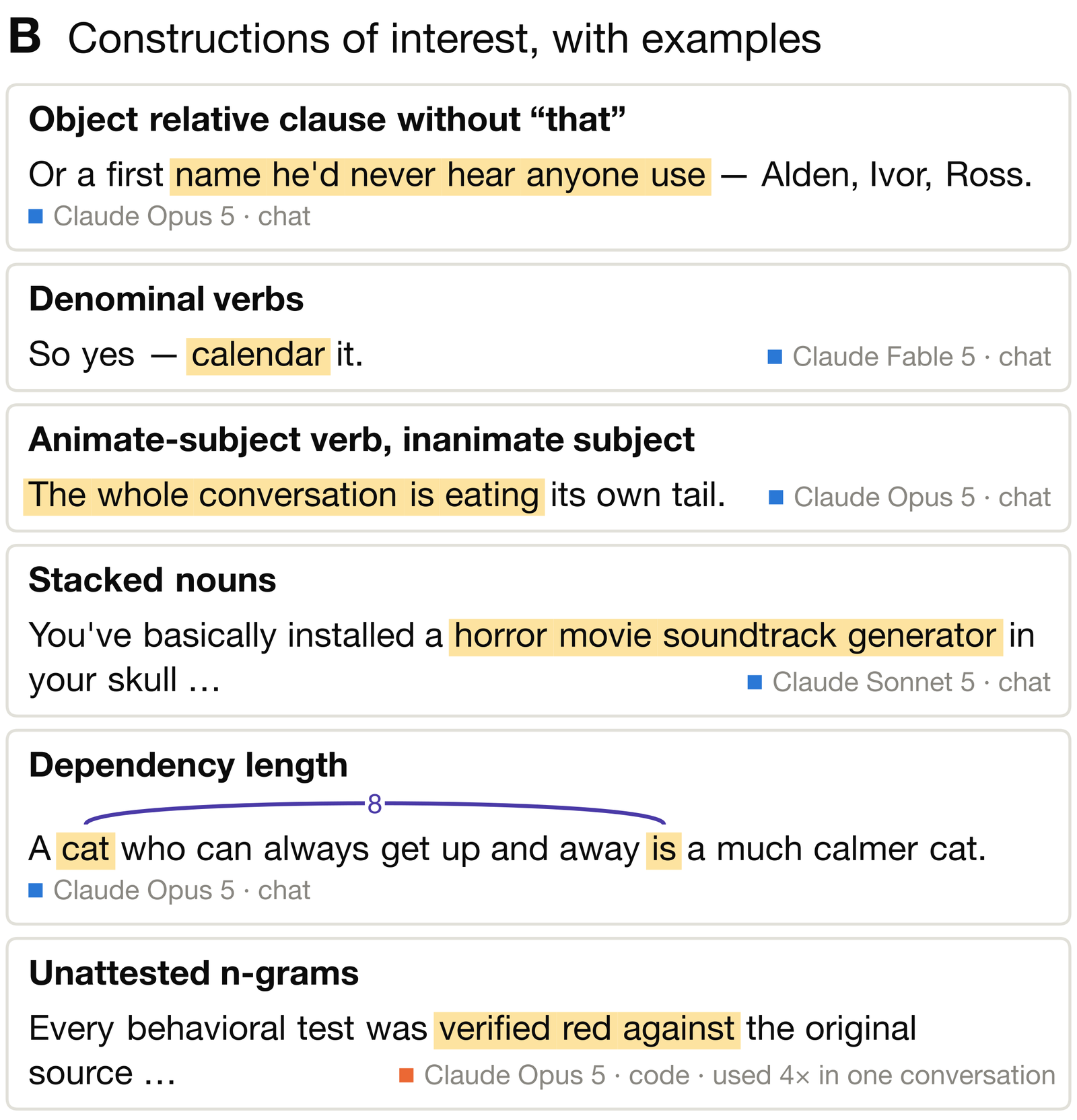
Counting alone proves little, since a coding answer may simply need denser language than a movie script. So the authors ran two checks. First, they compared each model with human writing of the same kind: movie and TV subtitles for chat, StackExchange for coding, and top-scored student essays from the PERSUADE 2.0 corpus. Second, they compared each model’s text with a paraphrase of that same text. Every sentence went from English to Japanese and back through Meta’s NLLB translation model, which keeps the meaning but swaps in more ordinary wording. If a construction shows up far more often in the original than in its paraphrase, the content did not require it. The model chose it.
What they found
Both checks pointed the same way. Against human writing, all nine models used more inanimate subjects with animate verbs and more rare word combinations, and in conversation most also used longer dependencies, more stacked nouns and more object relatives without “that”. Against their own paraphrases, almost every frontier model leaned on rare word pairs, nouns used as verbs, inanimate subjects and dropped “that”s.
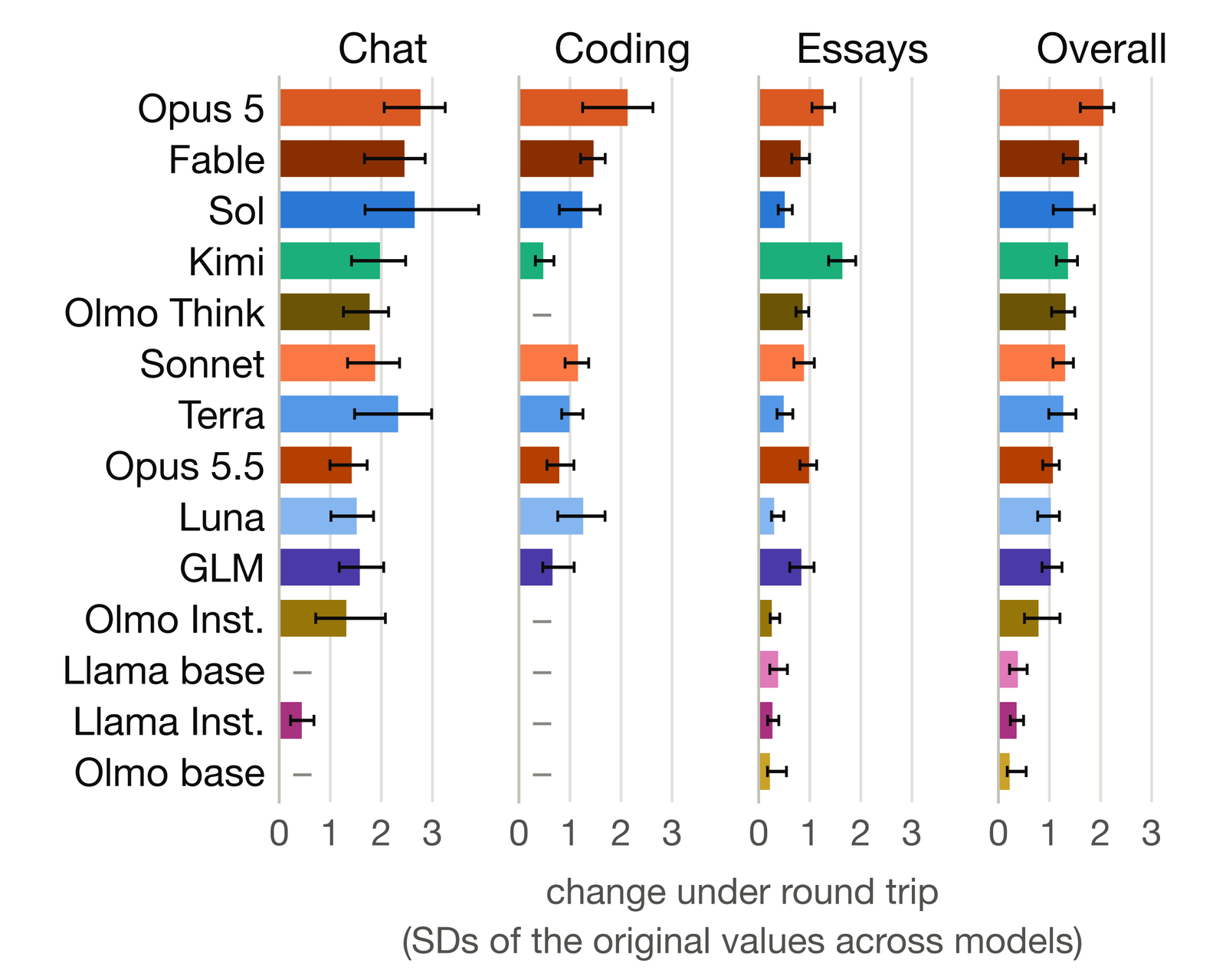
The more telling pattern is which models do it. In the round-trip comparison, the Llama models and the base Olmo model barely moved. Within the Olmo family, the gap grew with each stage of training, from base to instruct to the reasoning (“Think”) version, which ended up looking more like the frontier models than like its siblings. The base model is the same; what changes is the post-training. Essays showed smaller effects than chat and coding, perhaps because a single prompt leaves less room for the compression that builds up over a long back-and-forth.
Newer does not always mean denser, though. Claude Opus 5.5 scored lower than its predecessor Opus 5 on 19 of 21 difficulty-linked comparisons, eight of them with non-overlapping 95% confidence intervals. The authors call it “a quantifiable improvement” and point out that models can also be rewarded for communicating well.
The hypothesis: rewarded for answers, not for clarity
So why would models trained on human text drift away from it? The authors point at post-training. Modern models are refined with reinforcement learning on math, code and reasoning tasks, where, in their words, “models are rewarded for getting the right answer but not necessarily for clarity.” Add a limited context window, and you get pressure to pack more meaning into fewer words.
People face a version of that trade-off too, and they resolve it differently. Work on uniform information density by Roger Levy and T. Florian Jaeger showed that speakers tend to keep optional words such as “that” when what follows is harder to predict. A system rewarded only for being correct and short has no reason to do that.
The authors note a twist. Training on human feedback has been found to reward longer answers, so the push toward compression more plausibly comes from training on verifiable rewards, where a program checks the answer and no human judges the prose.
A small proof of concept
To test the idea, the authors fine-tuned a small open model, Qwen2.5-1.5B-Instruct (see the Qwen2.5 report), with GRPO, a common reinforcement learning method. The task was to turn a structured JSON description of an event into one English sentence. The reward was correctness and format minus a small penalty per token. Each item could be written two valid ways, one shorter by a known number of tokens, such as “He sent us a photo” versus “He sent a photo to us”. Both counted as correct.
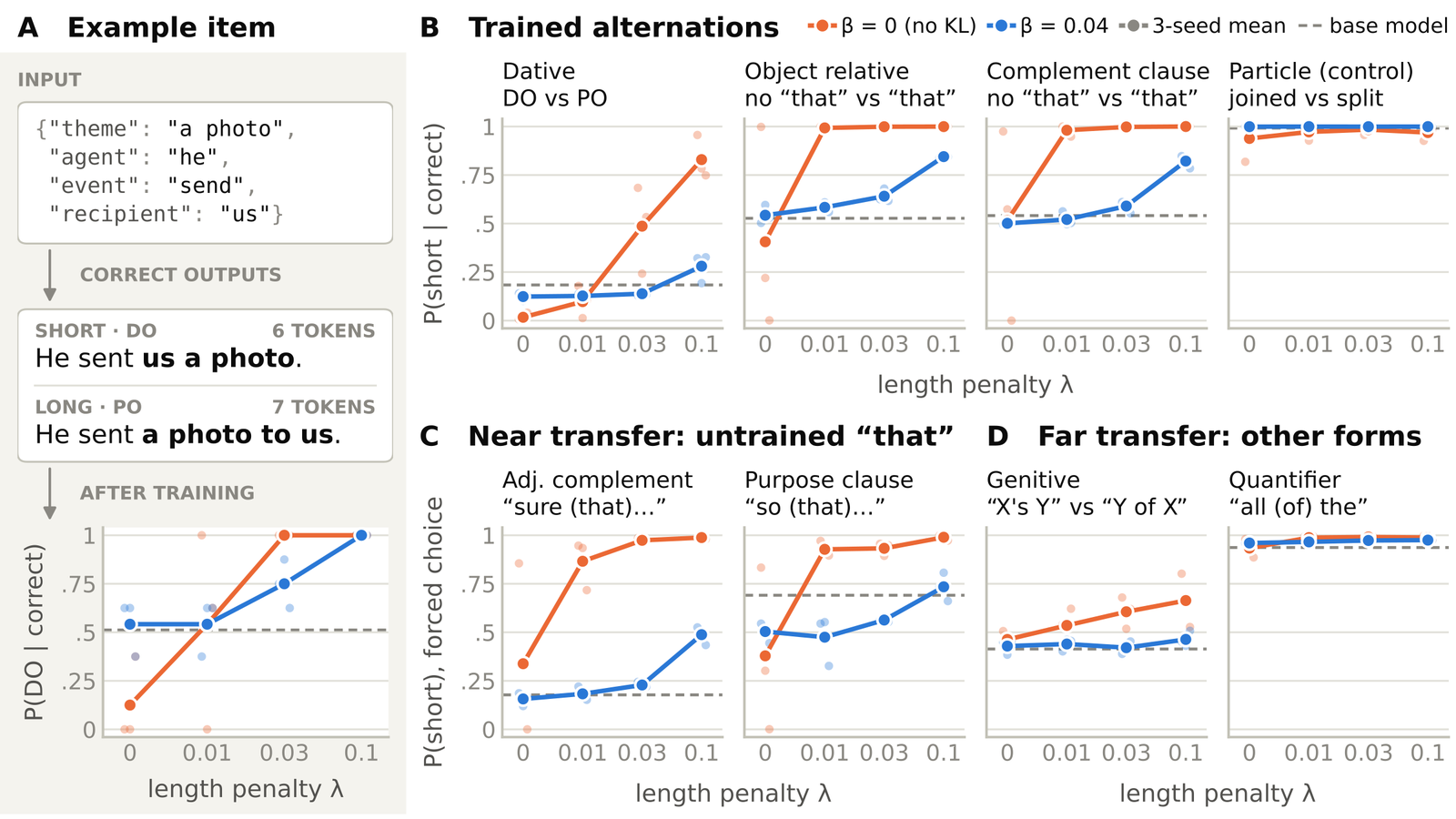
Without a length penalty, runs disagreed, ranging from 0% to 100% short forms depending on the random seed. With any penalty at all, and no regularization holding the model close to its original behavior, every run settled on the shorter forms, choosing them more than 98% of the time for the trained “that” constructions. With regularization, the shift was slower but went the same way. The preference carried over to untrained constructions with an optional “that”, such as “sure (that)”. Transfer to unrelated grammar was weak: of the four unrelated constructions tested, only the possessive (genitive) moved, and only without regularization.
The authors call this a “proof of concept”, and that is the right frame: a small model on a toy task, not a reconstruction of how any commercial model was trained. It shows that a length penalty alone can change grammar choices the model was never told about, while the model still solves the task.
One caveat: the six features are proxies for reading difficulty, not direct measurements of human comprehension. The study covers English only, a subset of models and a limited number of chat topics and code repositories.
Correct is not the same as clear
Most AI evaluation asks whether an answer is right. This paper is a reminder that a right answer can still cost the reader effort, and that a model can save tokens by spending your attention. Token efficiency and communication efficiency are different goals.
That matters most where reading is the point. Documentation, tutoring and onboarding material only work if people understand them on the first pass. In medicine, law and finance, a correct answer that a patient or client misreads is not much help. A dense paragraph can pass every automated check and still fail the person it was written for.
Here is the same trade-off in a workplace sentence:
Version A: “The app is slow because a few database queries take too long. Adding indexes to the columns they use most should fix it.”
Version B: “Query-latency-induced application performance degradation warrants workload-aligned database index optimization.”
B is shorter and sounds more expert. A is the one your colleague will act on.
One suggestion: when an AI answer feels dense, ask the model to rewrite it “for a reader who will read it once.” It costs one prompt.
The Opus 5.5 result suggests labs can fix this, if they measure it.
Compression is not communication.
Paper: Clark, Martin & Mahowald (2026), arXiv:2610.29162 (HTML). Figures under CC BY 4.0. More: Unite.AI’s coverage and Waterloo’s Q&A on “Claudish”.