NASA’s Nancy Grace Roman Space Telescope has passed an important early milestone: its primary science camera is powered up and operating in space. The Wide Field Instrument is a 300-megapixel infrared camera built to survey large areas of the sky while retaining the fine detail associated with space telescopes such as Hubble.
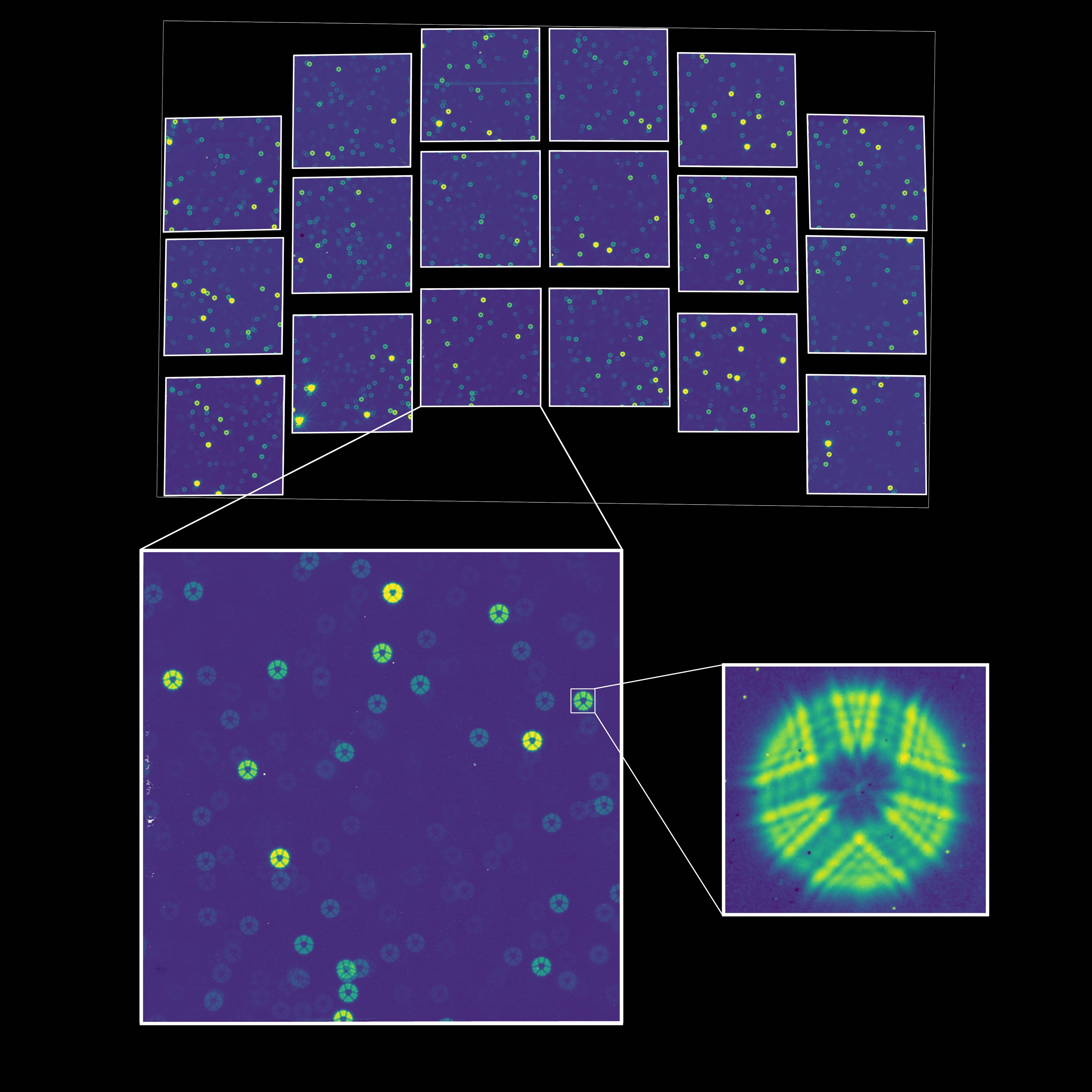
The activation comes while Roman is still traveling toward the second Lagrange point, L2, roughly a million miles from Earth. Before science operations can begin, the observatory is going through months of commissioning, calibration, cooling, and hardware checks.
Getting the Wide Field Instrument ready was deliberately slow. The team first kept it at minus 85 degrees Fahrenheit (minus 65 Celsius) for 10 days, allowing the instrument to dry out and decontaminate. On September 11, engineers switched off its heater and allowed it to cool to minus 225 Fahrenheit (minus 143 Celsius). Only then did they activate its 18 infrared detectors.
Together, those detectors provide a sensing area roughly the size of a laptop screen. Each exposure will cover a region of sky larger than the apparent size of the full moon. That combination of a large field of view and sharp imaging is central to Roman’s scientific role: rather than concentrating on small patches of sky, it will conduct broad surveys while preserving substantial detail.
Engineers subsequently activated the instrument’s calibration system and began transmitting test data back to Earth. They also exercised its element wheel in zero gravity for the first time. The wheel contains filters, prisms, and other optical elements that control which wavelengths reach the detectors and can separate light from astronomical objects into individual colors.
The final major check in this sequence involved the focus mechanism, which will eventually help focus hundreds of thousands of images. During these tests, the detectors continued cooling toward their operating temperature of approximately minus 300 Fahrenheit (minus 183 Celsius).
NASA reports that all of these assessments showed the Wide Field Instrument operating as expected. Roman remains on schedule for the release of its first science images in early 2027.
The instrument’s enormous survey capability will support studies ranging from planets outside our solar system to dark energy and the large-scale distribution of matter. Rather than simply producing individual detailed images, Roman is designed to build expansive views of the infrared sky that researchers can use across many areas of astronomy.
Roman’s other major imaging system is also awake. The Coronagraph Instrument is intended to demonstrate advanced technologies for directly imaging planets orbiting other stars. Its optics and masks suppress the overwhelming glare of a star so that the much fainter reflected light from an orbiting planet can potentially be detected.
Teams at Caltech/IPAC have now verified communication with the coronagraph’s software, thermal-control hardware, mechanisms, cameras, and avionics. That includes remotely operating mechanisms carrying masks, filters, lenses, and prisms.
Unlike the deeply chilled Wide Field Instrument detectors, much of the coronagraph operates close to room temperature. Engineers confirmed that its thermal-control system can bring the hardware to its intended operating temperature of about 72 degrees Fahrenheit (22 Celsius).
The coronagraph has subsequently entered a 30-day decontamination period, during which its detectors remain warm so that water and trace chemicals adhering to surfaces tend to leave them. The process will occasionally be interrupted for additional early calibration work.
The two instruments have very different jobs. The Wide Field Instrument is Roman’s survey workhorse, designed to gather enormous amounts of detailed infrared imagery across wide regions of the sky. The Coronagraph Instrument is a technology demonstration focused on the difficult task of separating the faint light of planets from the glare of their host stars.
For now, the significance is more practical than spectacular: the spacecraft is still being commissioned, not yet producing its planned science observations. But hardware that spent years being assembled and tested on Earth is now responding to commands, cooling to operating temperatures, moving mechanisms in zero gravity, and sending test data home.
As Wide Field Instrument scientist Josh Schlieder put it, “we now have confirmation that it is operational in space.” That confirmation brings Roman one substantial step closer to putting its unusually wide view of the infrared universe to work.