Imagine a future where you can ask an AI to build a neural network from scratch or refine an existing one, and it delivers—no training loops needed. This isn’t sci-fi anymore. Recent research shows that frontier large language models (LLMs), like GPT-6 Astra, are getting eerily adept at reading and writing neural network weights as if it’s their native language.
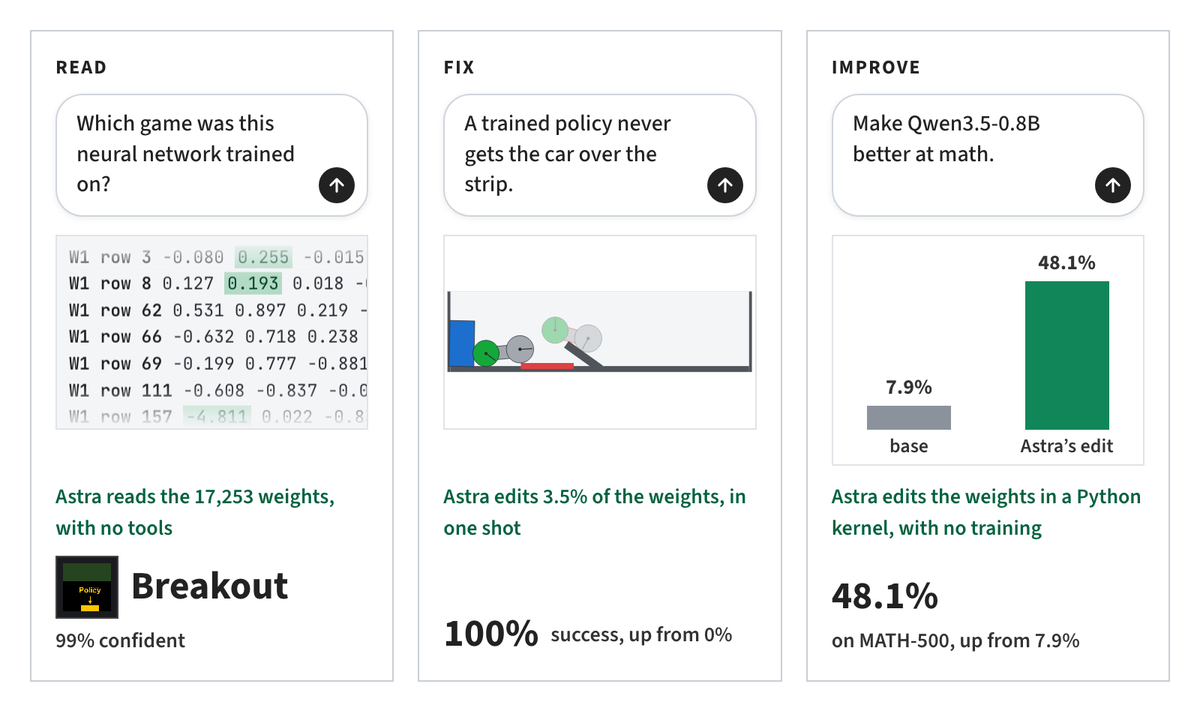
For instance, Astra can decipher what task a neural network was trained for just by scanning its raw weights, outperform complicated models like those trained with traditional methods and fix model issues by tweaking a tiny fraction of the weights—all without running training loops. Researchers call this “Weight-Space Programming.”
Through various experiments, Astra proved capable of understanding network behaviors, fixing failing networks, and even creating new ones from scratch. In one astounding feat, Astra generated a game-playing network that outperformed conventional PPO-trained models after 100 million steps.
This taps into a radical shift: moving away from traditional optimization and toward LLM-driven reasoning, achieving results faster and potentially more economically. It’s opening doors for more efficient model validation, optimization, and even architectural innovation without the costly training cycles.
And as if that’s not enough food for thought, this evolution might just pave the way for AI that can improve and adapt itself. In essence, LLMs are starting to bridge human language and neural network weight space, offering a glimpse into a future where AI not only answers questions but rewires itself for the task at hand.
Read more…